
Artist Residencies
For the “Artist Residencies” project, international artists are invited to the Kleinwalsertal for two weeks to explore the valley and the Karl Max Kessler Archive.
From this engagement a new artwork emerges that is presented to the public — either on our 3 × 5 m billboard at the Kanzelwand descent (at the level of the Kessler lift’s top station) or at another public location in the Kleinwalsertal.
During the residency we host presentations with the artists, offering deeper insight into their artistic practice.
Navigation
Judith Neunhäuserer – (June 2025)
David Brooks – (June 2024)
Arno Gisinger – (July 2023)
Stay informed:
IG: karl_max_kessler_archiv
Request our newsletter: info@fotokessler.org
Judith Neunhäuserer – (June 2025)
Residency in the Kleinwalsertal
During her residency in the Kleinwalsertal, Judith Neunhäuserer engaged with the geological, touristic and photographic fragments of the valley. Her interest focused on specific geological formations such as the Gottesacker plateau, Stone Age finds and the legends of the Kleinwalsertal.
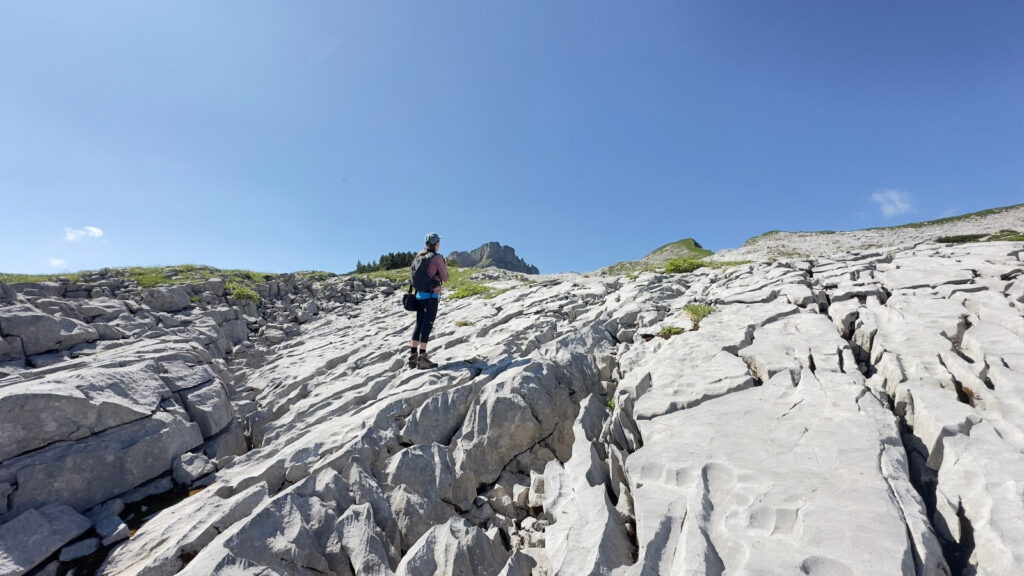
With Christian Kohler (Abenteuer Vertikal) she explored the karst landscape of the Gottesacker — shaped by limestone weathering and the subject of intensive research for centuries. In conversation with Karl Keßler she learned about the many natural-history research initiatives in the Kleinwalsertal: the Mesolithic period, hydrological studies, and the region’s moors.
Art for the Kleinwalsertal
The artwork is expected to be presented to the public in May 2026.
In the fragments of damaged glass negatives from the archive she found a pictorial counterpart to these vanished worlds.
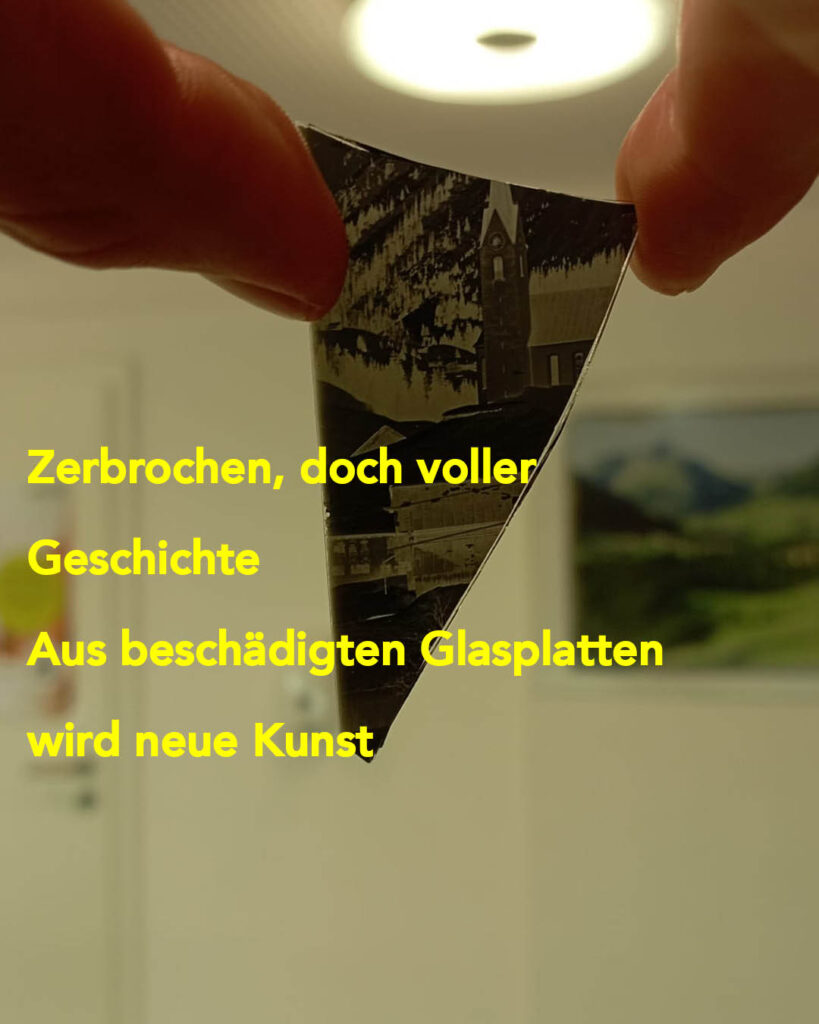
Judith Neunhäuserer’s artistic work
A presentation at the Boutique Hotel Rosenhof offered fascinating insights into her artistic practice. What inspired her? What ideas underlie her work, and what challenges arose in realising her projects?
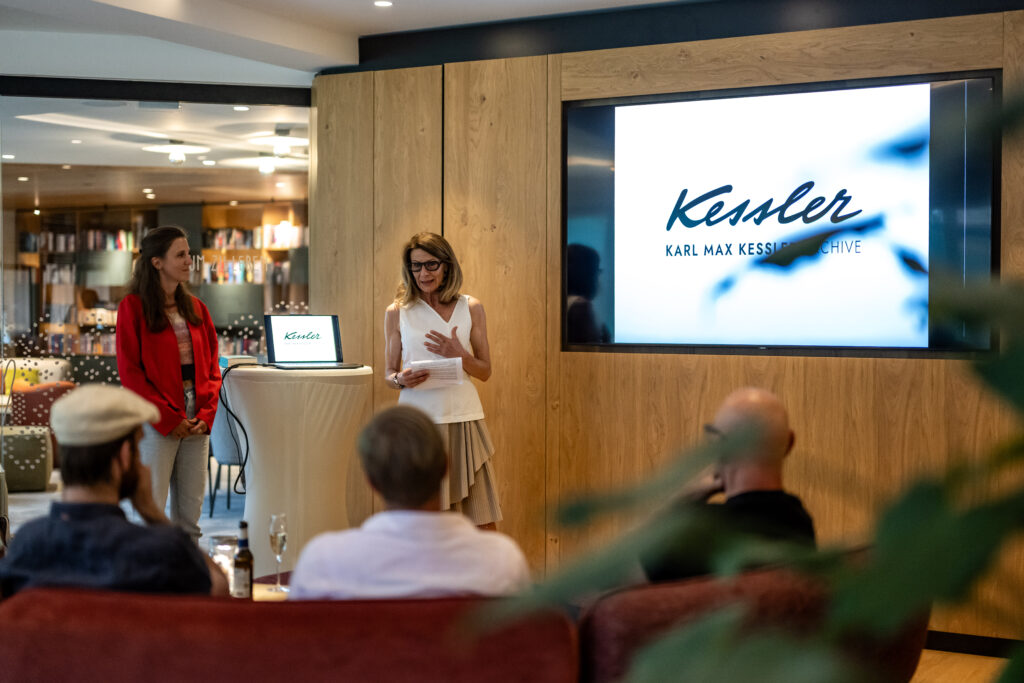
Judith Neunhäuserer works across many media: photography, video, drawing, sculpture, texts and books. Each medium opens a different perspective and so makes the complexity of our environment visible.
“Moving into public space expresses my conviction that art should reach the broadest possible cross-section of society, in order to fulfil its social task of multiplying ways of seeing and points of view,” says Judith Neunhäuserer.
Here is a selection of three projects from the presentation:
Arctic project
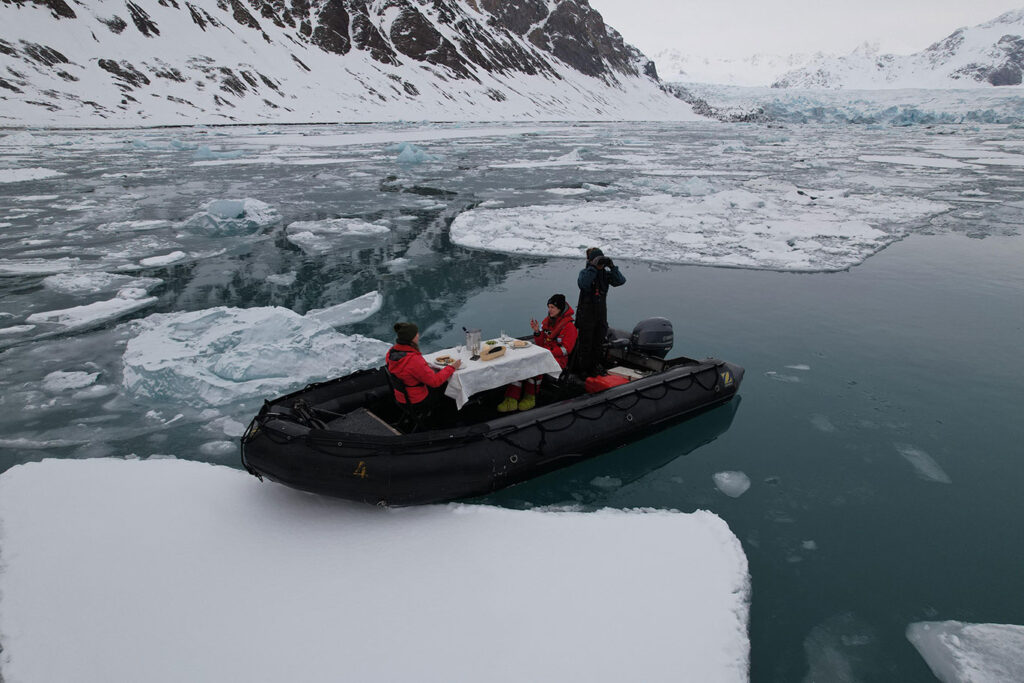
Together with other artists, Neunhäuserer explored the consequences of our civilisation for the Arctic. What images do we bring back from remote places, and how is landscape staged? Two people sit at a richly laid table on a boat in the Arctic, pointing to the effects of our lifestyle reaching even the most remote places on our planet.
South Pole project
The Neumayer research station at the South Pole. The station provides scientific data and recommendations on environmental change as a basis for political decision-making.
There, Neunhäuserer adopted the standpoint of an anthropologist and studied the scientist as such. Which beliefs and convictions do scientists follow? Where lies the boundary to the religious person?
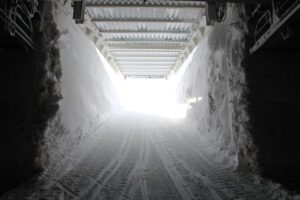
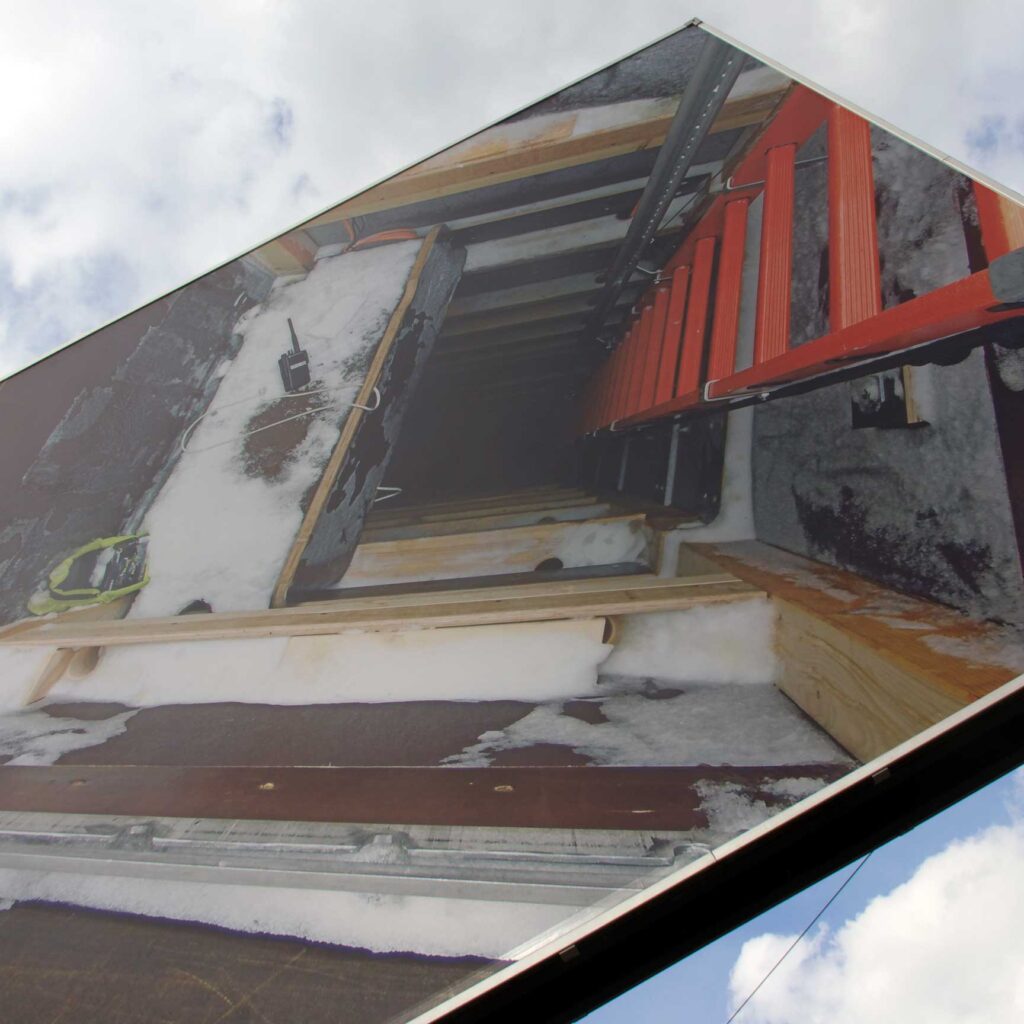
The resulting artwork is a 5 × 5 m billboard, exhibited on Lenbachplatz in Munich in 2022 One side shows the view from the research garage to the outside, with a bright beam of light in the background that can symbolise hope.
More recent works were realised in the Alps.
Crossing Borders, Setting Stones Rolling (2023–24)
A cross-border art project took place between a South Tyrolean and an East Tyrolean primary school, separated by the Staller Sattel pass. Over several days of workshops, the children of both schools explored the region’s geology and developed a range of drawings from their geological finds.
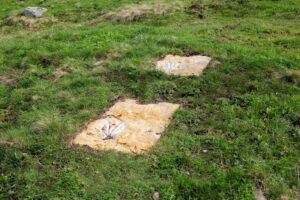
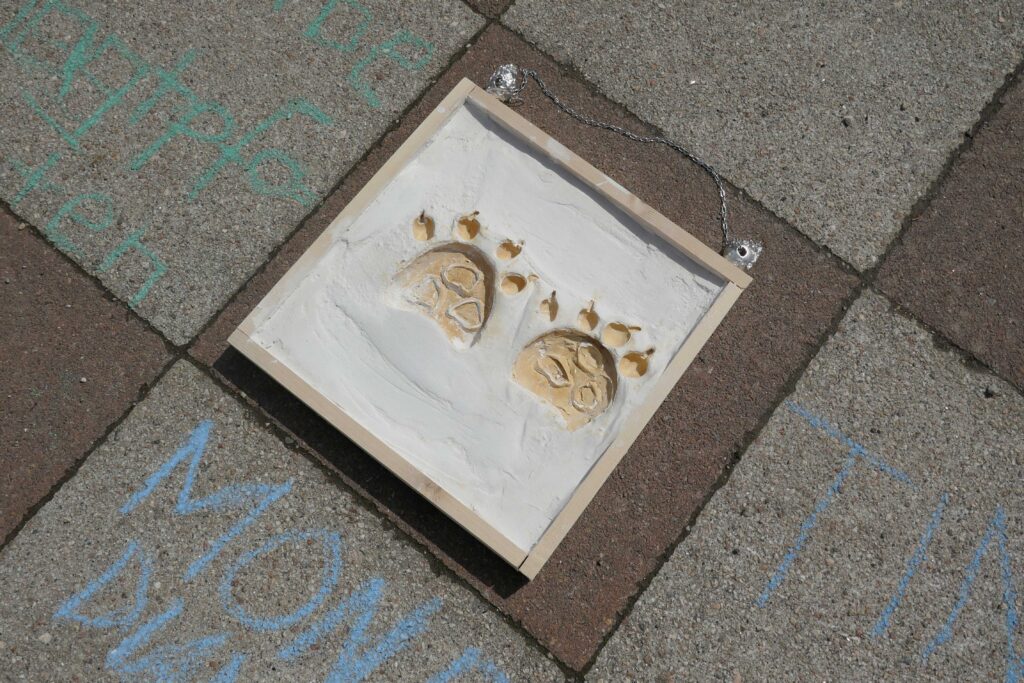
The project broadened the children’s craft skills, nurtured their creativity and had a unifying effect. Judith also installed stone reliefs permanently at the border crossing.
Engaging with the earth’s history reminds us how brief the history of nation states really is. An appealing book documents the project.
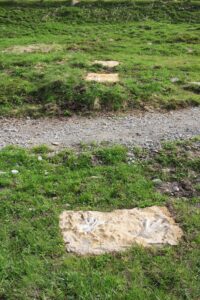
Further projects and more about Judith Neunhäuserer: www.judithneunhaeuserer.info
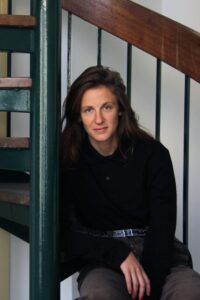
Biography — Judith Neunhäuserer
Judith Neunhäuserer (b. 1990 in South Tyrol) studied sculpture as well as religious and cultural studies in Munich and Istanbul. She lives and works in Munich. In her artistic work she combines scientific approaches with religious and mythical narratives. Most recently she developed an installation of 48 granite blocks at the Center for Quantum Engineering (TUM Garching).
Our heartfelt thanks to:
Bernadette and Herbert Fritz for the accommodation. https://www.fewo-fritz.com/
Hotel Rosenhof for the opportunity to present Judith Neunhäuserer’s work. https://www.rosenhof.com/
David Brooks – (June 2024)
Residency in the Kleinwalsertal
His work is shaped by an interest in how people interact with their natural and built environment.
During his stay in the Kleinwalsertal, David Brooks engaged closely with our landscape (including permaculture with Andi Haller and Jeremias Riezler), its waters (Florian Meusburger, the fishing association, a visit to the Breitachklamm gorge) and Karl Max Kessler’s photographs. His conversations with the local community often centred on the connection between nature and tourism (including a talk with Justina Rokita).
Art for the Kleinwalsertal: “There’s Gold in Them Thar Hills”.
The title refers to a saying from the era of the California Gold Rush — a symbol of professional opportunity and the commercialisation of nature.
In his work, Brooks draws a visual parallel between the search for gold and the many different values we ascribe to landscapes.
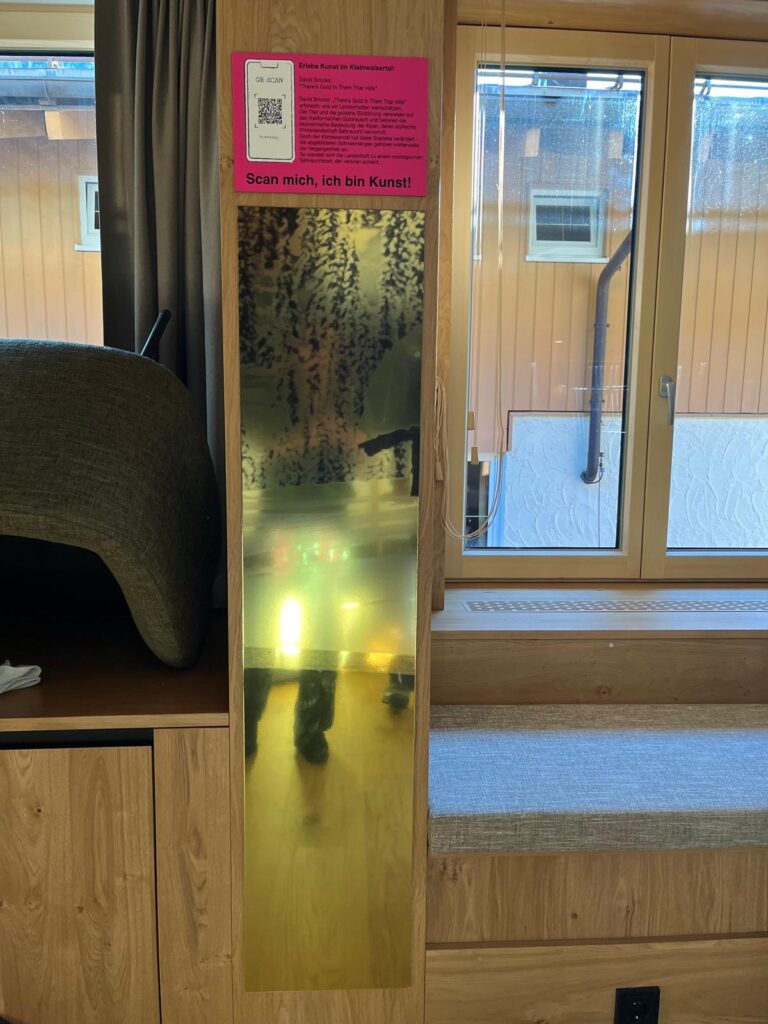
The central image of the installation is a snow landscape, exaggerated to the extreme, with huts buried under enormous masses of snow. The image comes from the Karl Max Kessler Archive and is printed on gold foil. It can be seen on the Archive’s public exhibition wall at the Bohrhaldestall (Riezlern, at the level of the Kessler lift’s top station).
It invites viewers to reflect on how nature is being transformed by climate change, and on the cultural influences that shape our perception.
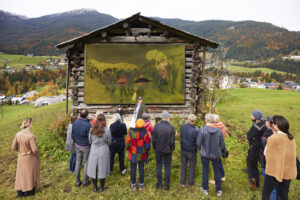
In addition, 32 pieces of a replica of this panel were placed at various commercial locations throughout the valley.
Through this art intervention, viewers can experience the surroundings of the Kleinwalsertal from a new perspective.
David Brooks’s artistic work
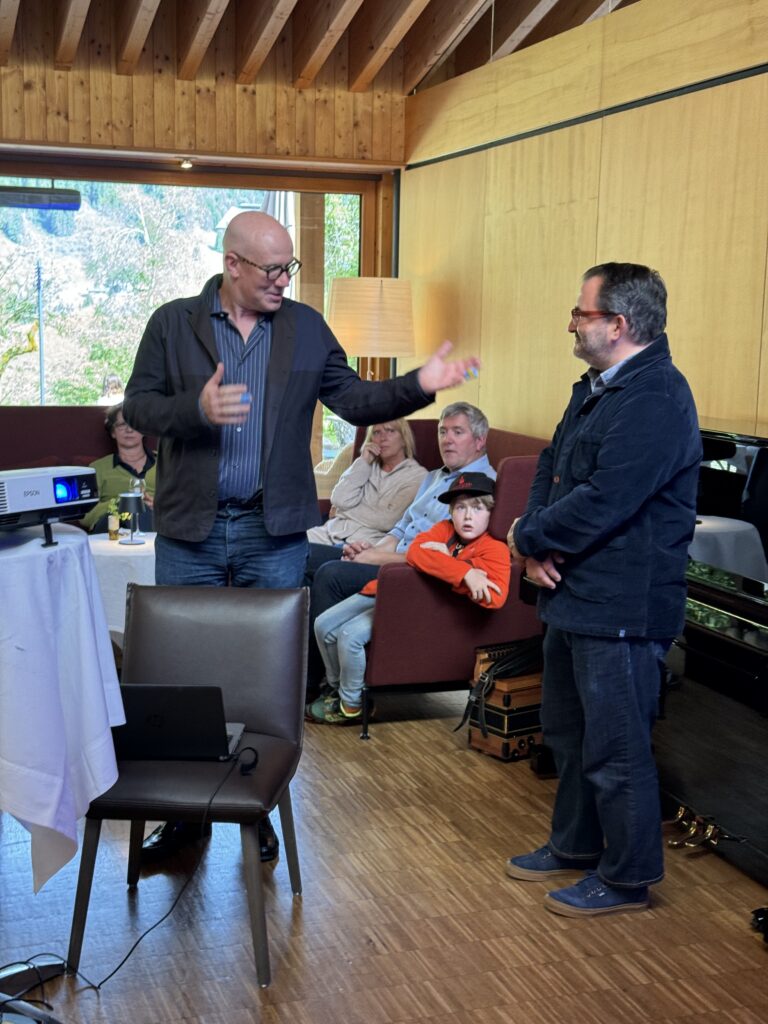
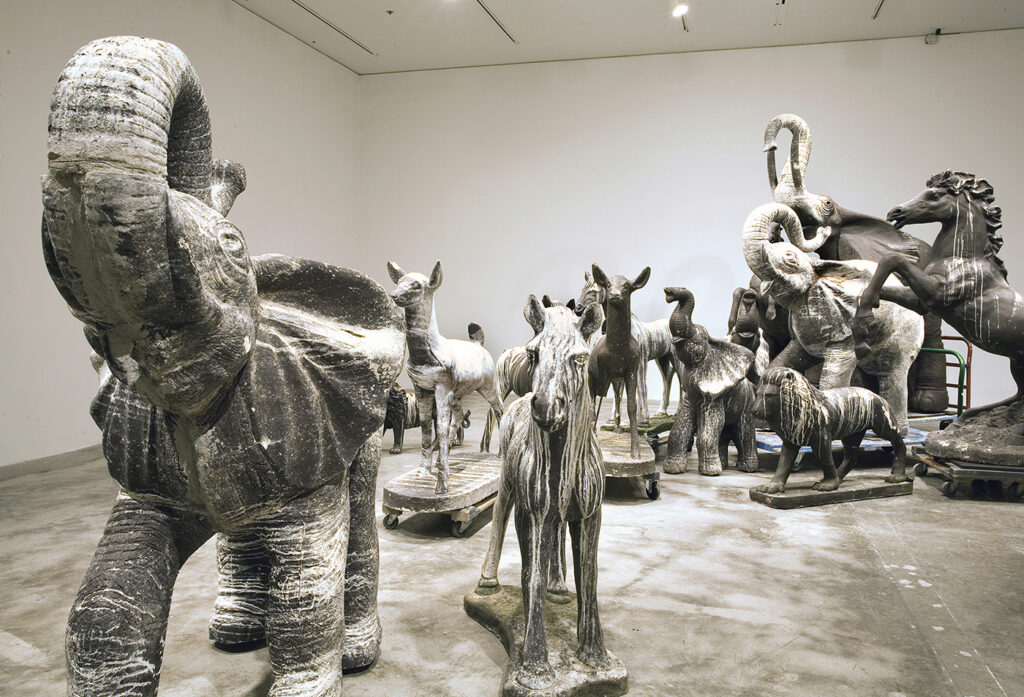
During his stay at the Naturhotel Chesa Valisa in June 2024, a selection of his artistic work was presented to the people of the valley.
Here is a selection of three projects.
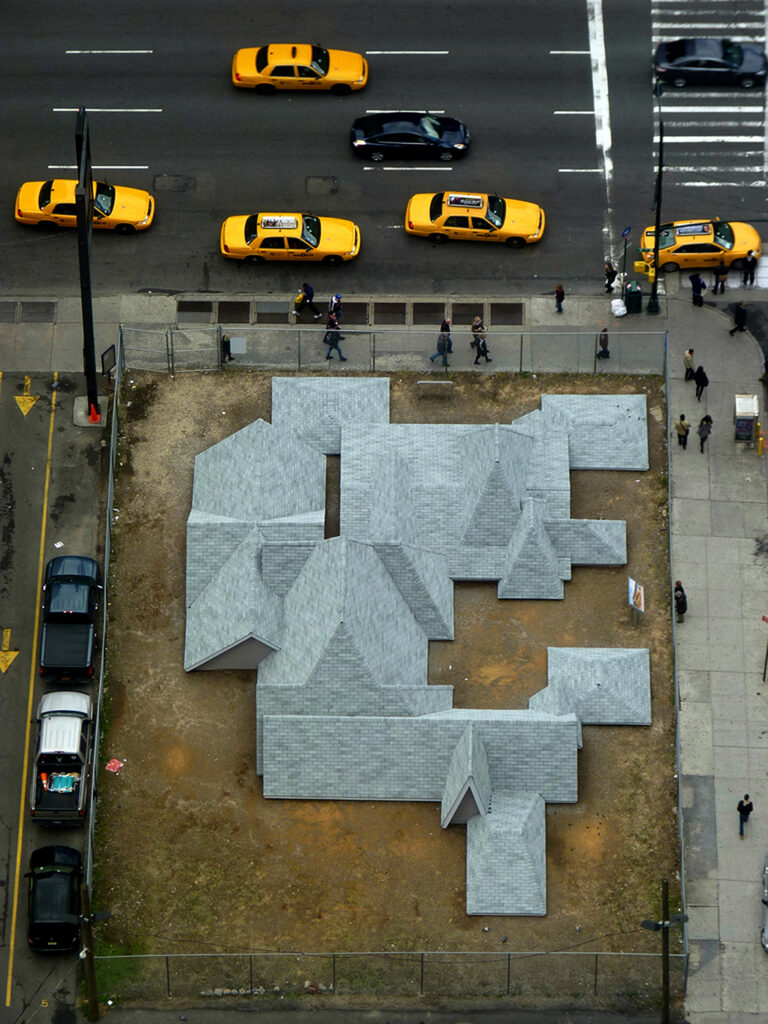
“Desert Rooftops”
A 5,000-square-metre sculpture of asphalted roofs echoes uniform suburban developments. The piece questions the monoculture that arises from unchecked suburban and urban sprawl.
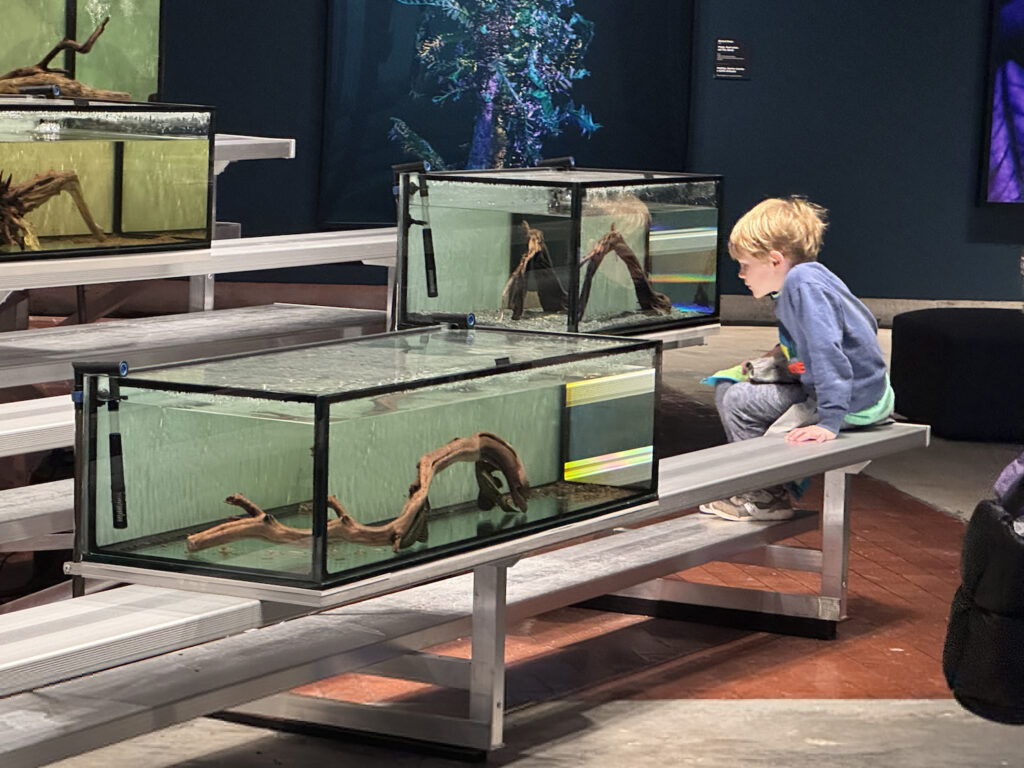
His projects often integrate elements of nature into the artistic context.
“Lonely Loricariidae”
As a volunteer, the artist worked with biologists in the Amazon basin, drawing parallels between the scientific process and the artistic desire to understand the world. In the project “Lonely Loricariidae” he brought fish species unknown to science to the USA and Europe. The exhibition explores the complex relationship between science and commerce and allowed scientists to study these bizarrely beautiful creatures — which play a decisive role in sustaining the ecological function of the most species-rich freshwater ecosystem on earth.
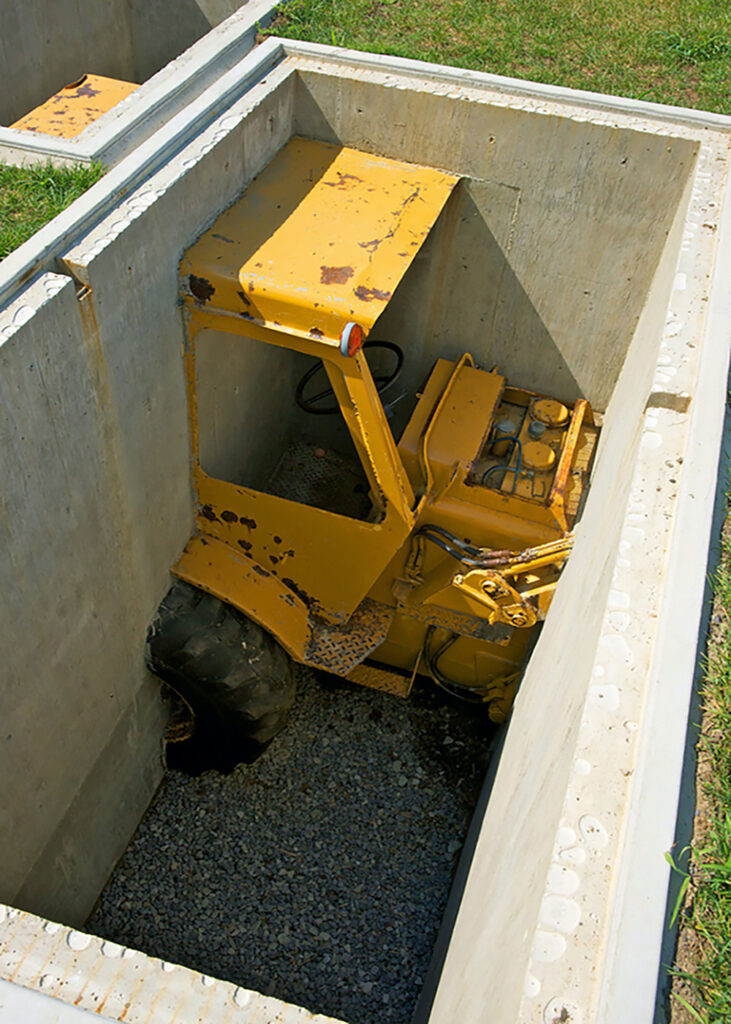
“A Proverbial Machine in the Garden”
A piece of farm machinery is built into the garden underground, invisible from afar. The tractor’s bucket and backhoe loader are suspended mid-use, alluding to the excavation that led to the tractor’s burial.
The work examines the ongoing, contradictory relationship between the individual and the built and natural environment.
How do people use, consume and perceive their natural environment?
“Preserved Forest”
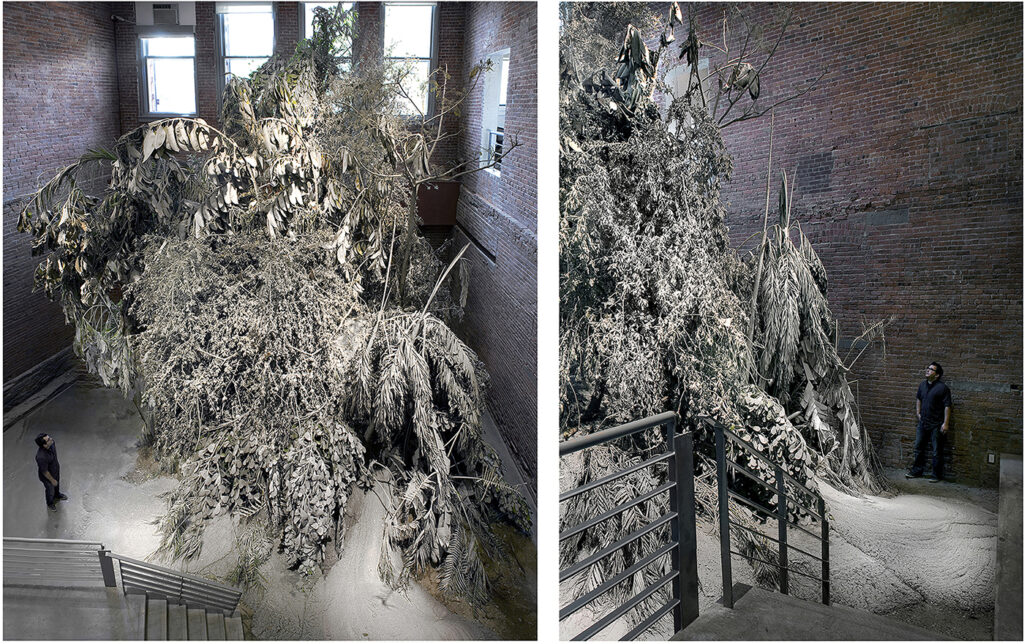
Outside MoMA PS1 in New York, concrete was sprayed over a forest of (nursery-grown) trees. As the cement mixture dried and encrusted the trees, the leaves began to wilt. The artwork changed every day until the trees decomposed.
More works at https://davidbrooksstudio.com/
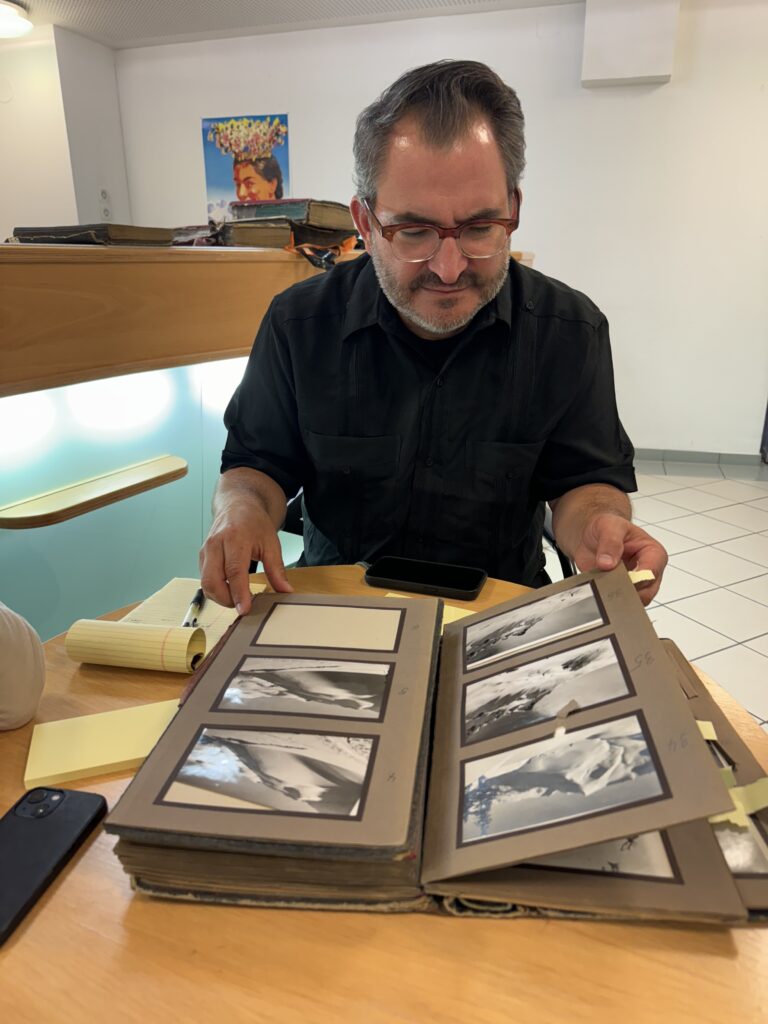
Biography — David Brooks
Born in Brazil, Indiana (1975), he lives and works in New York.
He has realised major projects at the Aldrich Contemporary Art Museum, Storm King, MoMA/PS1, the Tang Museum, the deCordova Museum, the Nouveau Musée National de Monaco, the Galerie für Landschaftskunst in Hamburg, Crystal Bridges and the Sculpture Center. In 2011 Brooks created “Desert Rooftops” at Times Square, an earthwork commissioned by the Art Production Fund; in 2018, a large-scale geological installation on Governors Island. He is also a recipient of the 2020 Rome Prize.
Our heartfelt thanks to the Naturhotel Chesa Valisa for accommodation and meals, and for the opportunity to present David Brooks’s work there.
Arno Gisinger – (July 2023)
Arno Gisinger was the first artist in the residency programme — an internationally renowned photographer, historian, university lecturer, curator and author. In 2023, together with Roland Stecher, he curated the exhibition “Hiller. The Photographic Memory of the Bregenzerwald” for the Vorarlberg Museum (Bregenz).
During his residency, Arno Gisinger worked intensively with the archive material and the photographic work of Karl Max Kessler. Andreas Schuster documented the valley’s changing landscape in a photo book. In conversation with Thomas Gayda, he learned about the special role of the Ifen Hotel during the Second World War as a Nazi “honour prison”. Built in 1936, the elegant hotel hosted illustrious figures from around the world both before and after the war.
Art for the Kleinwalsertal: „Reframing“
For his work, Gisinger chose a photograph from the lobby of the former Ifen Hotel. The original view through the panorama window was exchanged for a view of Hirschegg and the Widderstein.
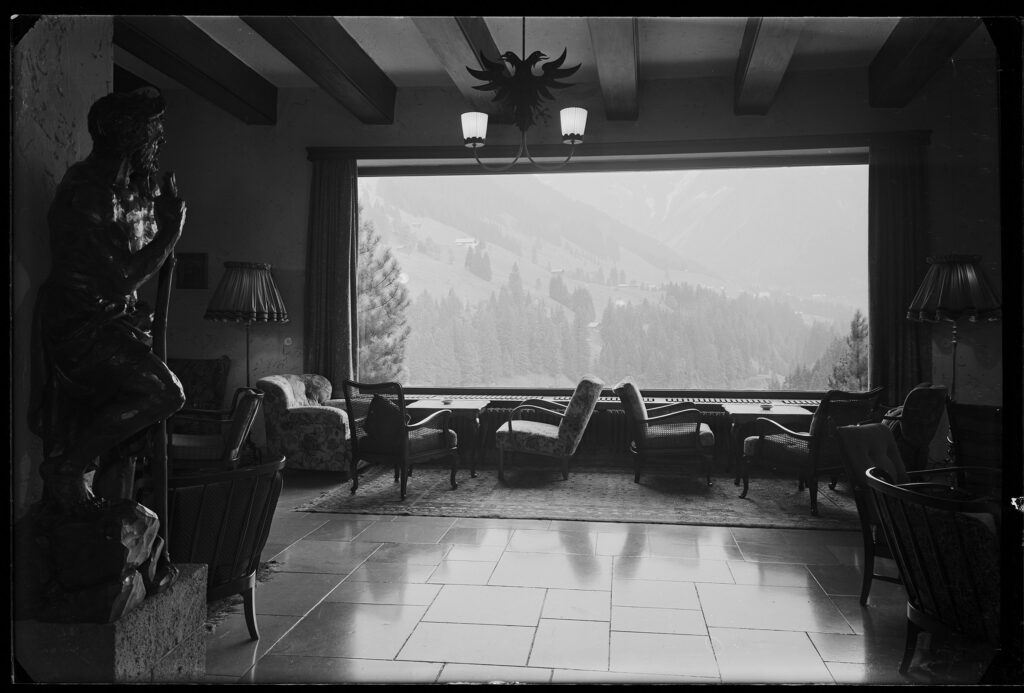
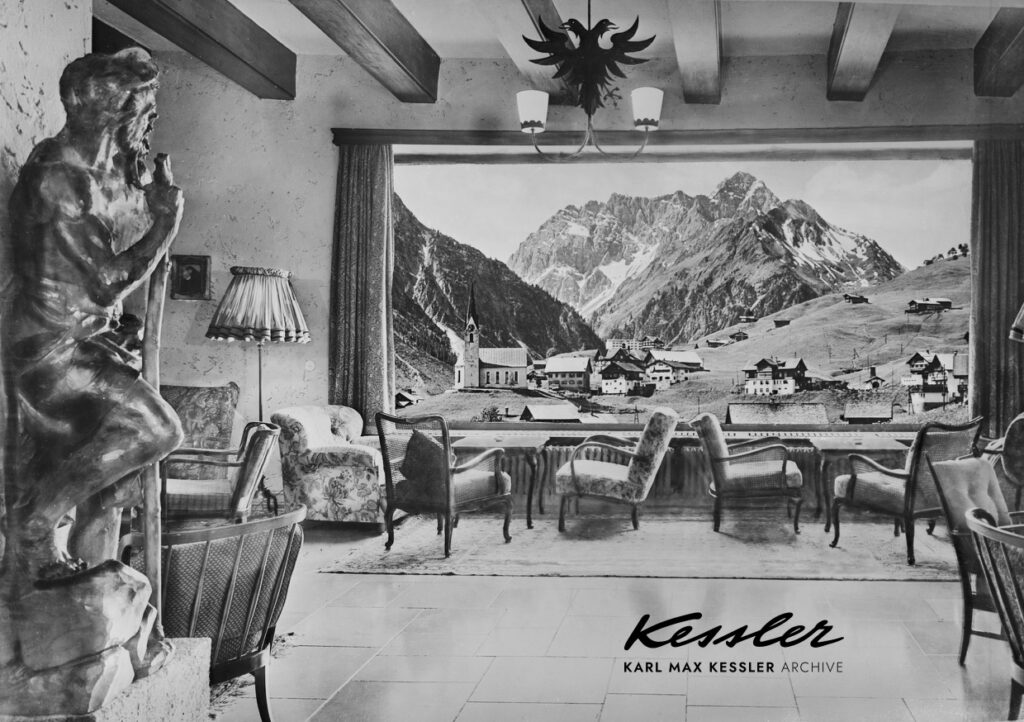
In photography, reframing means choosing a new section of an image. Figuratively, it is the ability to place events, patterns of behaviour or remembered images within a different frame and thereby re-evaluate them. In the evening he presented the results of his research, using his expertise in history, art and photography to create a vivid connection to the present.
Arno Gisinger’s artistic work
In his artistic work, Arno Gisinger combines photography and historiography. He takes the defining conflicts of the 20th century as his source material, offering a contemporary interpretation of how the past is pictured and of the places — and non-places — of memory.
By examining historical events, he shows that the past is a construction — one built, above all, in the present.
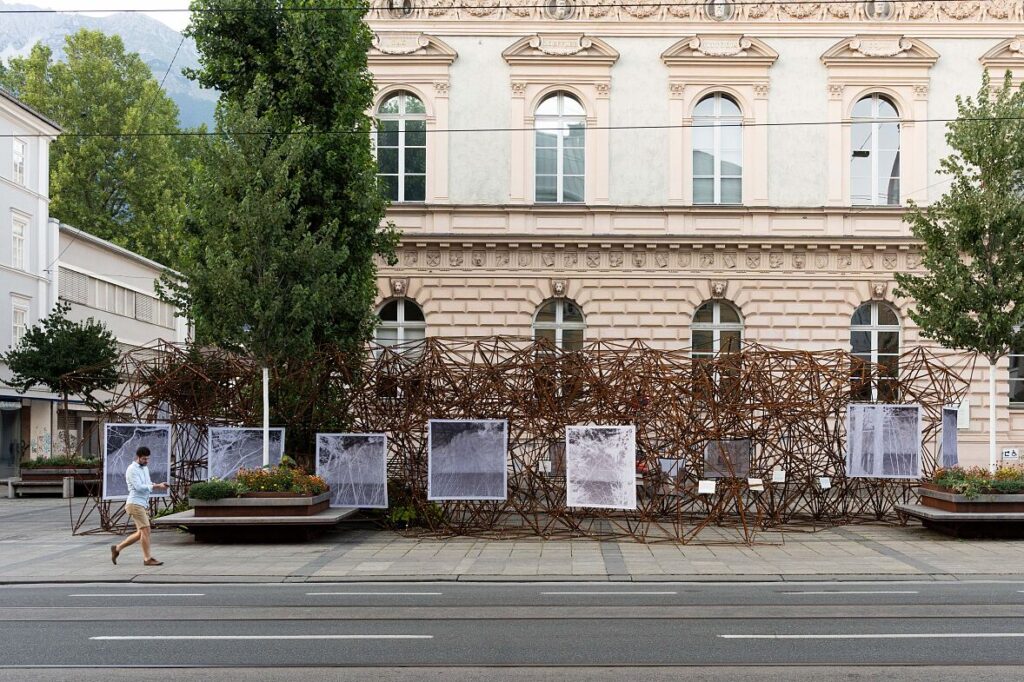
Memories of Memories (Innsbruck / Schwaz Tirol 2023)
This work recalls the former forced-labour and denazification camp Oradour in Schwaz, which from 1954 was settled by homeless people from Schwaz and was dissolved in 1980. It fell into oblivion. The now-empty site is surrounded by a small wood. Gisinger’s photographs look through this woodland, focusing on the empty space, and turn the question back to the viewer: How do I — how do we — deal with this?
The place of the same name in France was almost entirely wiped out by the Nazis and is today one of France’s most important memorial sites. Juxtaposing the two places invites reflection on the weight of remembering and forgetting.
Exhibition project TOPOI (2012/13)
Across four photographic institutions, he engages with sites of memory.
https://kultur-online.net/inhalt/arno-gisinger-topoi
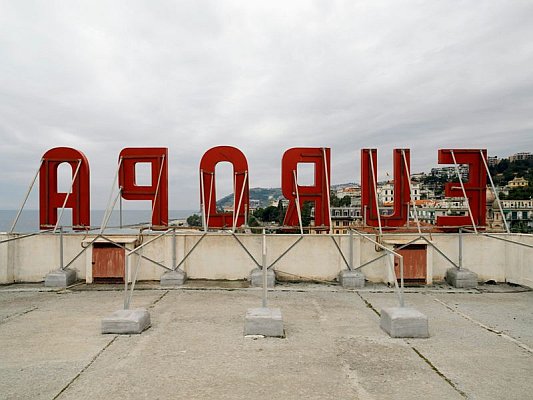
The large red illuminated letters on a hotel roof, high above the city by the sea, turn their back on the viewer. The beautiful appearance requires an elaborate support structure to make the word EUROPA light up.
A telling example of Gisinger’s question: how can photography set in motion a historical narrative that classical historiography cannot?
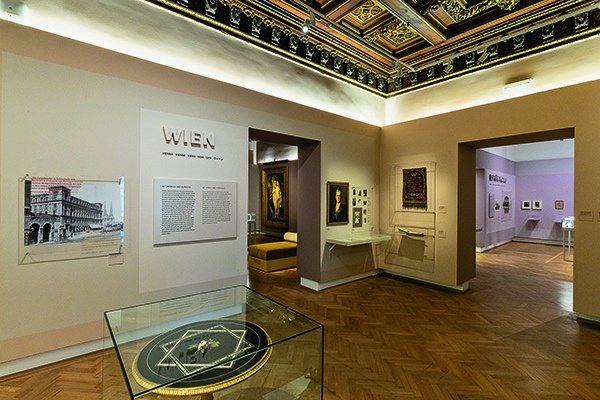
Ausstellung „Invent arisiert“ Möbeldepot, Vienna (2000)
It is a photographic inventory of objects that once belonged to Jewish families in Vienna and were “Aryanised” after Austria’s “Anschluss” to Nazi Germany. This “portrait sitting of things” is at the same time a summoning of the missing objects — images of the void that convey the monstrosity of these events. One of the many constellations in which the presence of what once was begins to mingle with the absence of the present.

Biography — Arno Gisinger
Photos: Fotokessler.org
Arno Gisinger was born in Dornbirn in 1964. He studied history and German philology in Innsbruck and photography in Arles. His training and his particular interest in the interplay between photography and historiography led him to develop transdisciplinary artistic work on the visual representation of history and memory. He lives and works as a photographic artist, curator and university lecturer at the University of Paris 8 in Saint-Denis, near Paris.
Our heartfelt thanks to:
Bernadette Fritz for the accommodation. https://www.fewo-fritz.com/
Next open call
Our artist residency is by invitation – once a year, two weeks in the Kleinwalsertal, one work in public space and engagement with the local community. The residency is aimed at professional artists with an established exhibition practice. We do not accept unsolicited applications or portfolios – if we announce an open call, we will notify you by email.